Pony Town - Social MMORPG
- 4.2
- Rating
- 10.00M
- Installs
- Free
- Price

 Analysis by App-foxy
I went into Pony Town expecting a light social game, but its appeal is more deliberate than the cheerful pony theme suggests. You create a character, enter a shared world, meet other players, and decide what kind of session you want: a quiet customization break, a conversation with strangers, or an improvised roleplay scene. It is free to play, rated for Everyone, and developed by Pony Town Team, but it is not simply a small dress-up toy. The interesting part is how much of the experience depends on your choices before, during, and after each interaction.
That freedom is also the reason I would not recommend it to absolutely everyone. Pony Town - Social MMORPG does not guide you through a traditional adventure with a clear quest chain, combat loop, or obvious finish line. If you need constant objectives and measurable progress, you may find the open-ended format slow. If you enjoy making your own reasons to return, however, the game has a friendly kind of depth that becomes clearer over time.
What kind of social RPG is Pony Town?
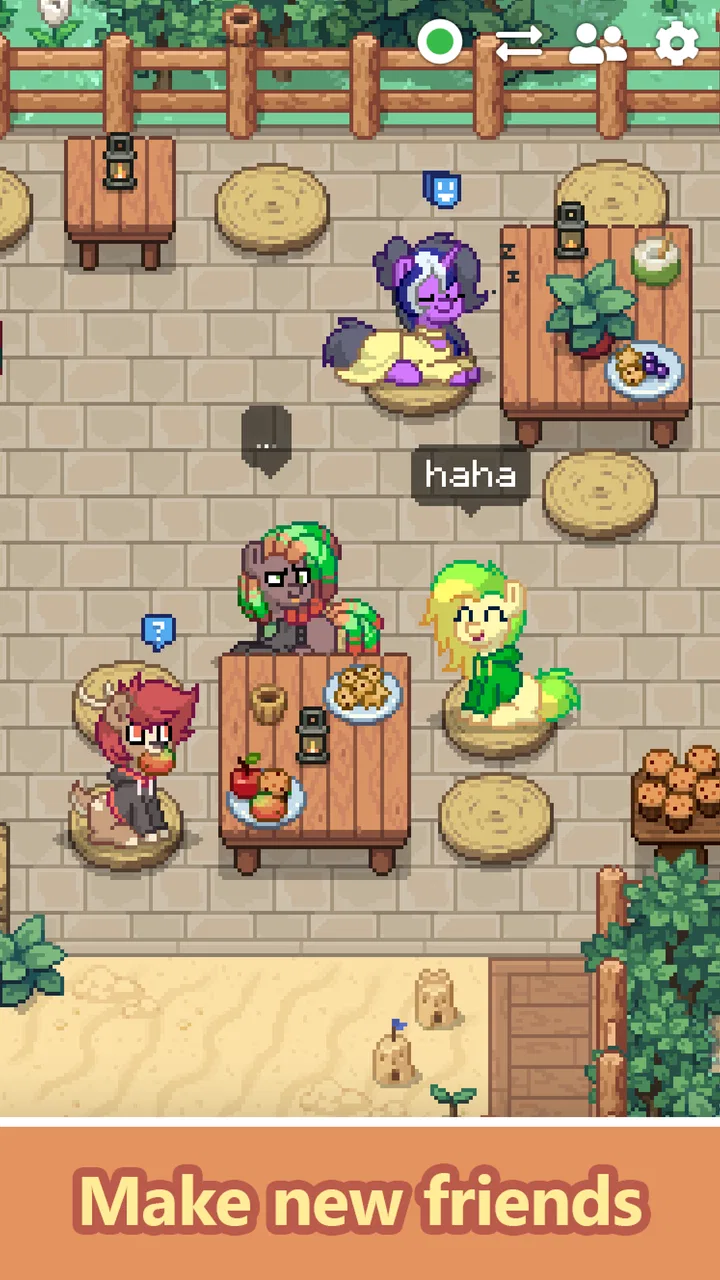
The basic idea is easy to understand. You make a custom pony, place yourself in a shared town, and use the environment and nearby players as the material for social play. The role-playing element comes less from following a scripted hero’s journey and more from choosing an identity, presenting it visually, and deciding how you want to participate in the community around you.
You May Also Like

 Blood Strike: 2.5 Anniversary
Blood Strike’s Loadouts Turn Every Drop Into a Tactical Gamble
A close look at Blood Strike’s custom loadouts: how fast access to signature weapons reshapes its battle royale rhythm, rewards preparation, and narrows the gap between fights.

 Pandora - Music & Podcasts
Pandora’s Music Is Easy to Start, but Harder to Recover
Pandora’s strength is its low-effort path from a seed to a station. Its weak spot is how much confidence it asks you to place in connection, setup, and quiet recovery.

 8 Ball Pool
 Is Built on Rivalries, Rematches, and Routine
A close look at the rivalries, rematches, shared routines, and unanswered safety questions that turn a quick pool match into a persistent mobile community.

 Samsung Music
’s Quiet Strength Is Playing What You Already Own
Its reach comes less from spectacle than from dependable access to a personal library. That simplicity is both the app’s strongest retention engine and its ceiling.

 AccuWeather: Weather Radar
AccuWeather Review: A Quick, Clear Forecast for Everyday Decisions
For everyday plans, the best forecast is the one you can understand quickly. AccuWeather makes rain timing, radar, and local conditions easy to act on, with a few trade-offs.

 Hill Climb Racing
Why Hill Climb Racing Still Turns Crashes Into One More Run
A tiny car, a bumpy hill and one more upgrade: Hill Climb Racing keeps resurfacing because its simple chaos makes every near-miss feel personal.
More From Our News Desk
View All News


That makes the game feel closer to a persistent social playground than to a conventional role-playing game. In a typical mobile RPG, I expect missions, battles, equipment, and a progression ladder that tells me what to do next. Here, the central question is different: what do I want to do with the time I have? I might spend a short session adjusting a character, wander around looking for conversation, or stay longer when a group activity develops naturally.
The game has reached more than 10 million installs, with an average rating of 4.2 from around 148 thousand ratings and roughly 3.6 thousand written reviews. Those figures suggest that the social format has found a substantial audience, but they should not be mistaken for a promise that every player will enjoy the same experience. Pony Town rewards curiosity and patience more than it rewards rushing.
The current version is 1.3-2387, and the game runs on Android from version 6.0 onward. It is free to start, while optional in-app purchases range from $2.99 to $291.99 per item. That wide purchase range is worth noticing before you play, especially if the device is shared with younger family members. The game itself is accessible without treating payment as the entry ticket, but the presence of optional purchases means I would still set expectations clearly before handing over the phone.
The first important decision is how you present yourself
Character creation is not merely a cosmetic opening screen. In a social game, the appearance you choose becomes a quick signal to everyone else. A simple, readable design can make it easier for people to recognize you later, while a more unusual character can help you stand out in a busy area. I found it useful to think about the character as a social tool rather than as a permanent fashion statement.
One practical approach is to create a design that communicates your intended role. If you want relaxed conversations, a friendly and uncluttered look may invite more approachable interactions. If you are joining roleplay, a stronger visual theme can make it easier for others to understand the kind of scene you want. The trade-off is that highly specific designs can limit your flexibility when the mood changes.
I also recommend taking time to remember the parts of your character that matter most to you. In a crowded social space, small visual details can be more useful than trying to make every element elaborate. A recognizable color combination, silhouette, or accessory can help friends find you without requiring a formal party system or a long explanation.
Planning a session instead of chasing a checklist
Pony Town works better when I decide what sort of session I want before opening it. For a quick visit, I might focus on one simple goal: adjust my character, walk through familiar areas, or look for a conversation that feels welcoming. For a longer visit, I can leave room for roleplay to develop instead of expecting the game to provide a sequence of tasks.
This small change in mindset prevents one of the most common disappointments. A player who enters expecting a conventional MMORPG can spend the first few minutes searching for quests or rewards that are not the point of the experience. A player who enters expecting a shared social world is more likely to notice the value in observing, choosing where to stand, and deciding when to join a group.
There is a genuine decision space in that freedom. Do I approach an active group or wait for a quieter opening? Do I keep my character consistent for roleplay, or change the design to match a new idea? Do I stay in one area to build familiarity, or move around to discover different conversations? None of these choices is presented as a dramatic strategic prompt, but they shape the quality of a session more than speed or reflexes do.
Risk, reward, and the social side of play
The rewards in Pony Town are mainly experiential. A good interaction can turn an ordinary few minutes into a memorable session, while a confusing or uncomfortable exchange can make the same space feel empty. That makes social judgment more important than it first appears. I have found that the best results usually come from treating other players as people with their own plans rather than as background decoration.
Approaching strangers carries a small social risk. They may be busy, already involved in roleplay, or simply not interested in chatting. The reward is the possibility of finding a group or conversation that gives the game a sense of place. A low-pressure greeting, a relevant comment, or waiting near an active scene is usually more effective than forcing attention immediately.
The same principle applies to roleplay. Entering someone else’s scene without understanding its tone can disrupt it, even when the intention is harmless. I prefer to observe for a moment, identify what kind of interaction is happening, and then contribute in a way that fits. That extra pause is one of the most useful habits I developed because it reduces awkwardness without making the game feel formal.
Another trade-off involves customization. Spending time on appearance can make the character feel personal and improve recognition, but it can also become a substitute for actually playing. I set a stopping point for design work and then take the character into the world. Otherwise, it is easy to keep refining details while missing the social situations that make those details meaningful.
How to handle quiet sessions
Not every visit will produce an exciting conversation. That is not necessarily a flaw, but it changes how I judge the game. When the town feels quiet or the available groups do not match my mood, I use the time for low-pressure exploration or character planning rather than treating the session as a failure. This makes the game more sustainable for me than expecting every login to become an event.
Players who need reliable solo content should think carefully about this point. Pony Town can be relaxing when I want an unstructured space, but it is not the best replacement for a story-driven RPG with a guaranteed sequence of encounters. A single-player adventure, a traditional online RPG, or a game built around missions would be a better choice when I want clear goals and dependable progress.
Making everyday use fit the game
A realistic use case is a short evening break after work or school. I can open the game, spend a few minutes checking my character, walk toward a familiar area, and decide whether I want conversation or quiet observation. If a roleplay scene is already forming, I can join carefully; if not, I can leave without feeling that I have failed a daily task.
That flexibility also makes Pony Town suitable for players who enjoy creative communities but do not always have time for a long campaign. The experience can begin with a brief visit and expand when the social setting feels right. The limitation is that the quality of the session depends heavily on who is available and how comfortable I am initiating or responding to interaction.
Because the age rating is Everyone, I would still encourage parents and younger players to approach the social side thoughtfully. An age label does not remove the need for sensible online habits. I would avoid sharing personal information, leave conversations that feel uncomfortable, and use the game’s social spaces in a way that respects boundaries. Those habits are especially important in any shared world where meeting new people is part of the appeal.
Adapting when the first plan does not work
Adaptation is where Pony Town becomes more interesting than its simple premise suggests. Since there is no single correct way to play, I have to adjust my approach based on the atmosphere around me. A crowded area may be good for finding activity but difficult for being noticed. A quieter location may offer better conversation but require more initiative.
I learned to change one variable at a time. If a character design is not attracting the kind of roleplay I want, I can simplify its visual message rather than redesigning everything. If a conversation is not developing, I can move to another group instead of repeatedly trying to revive it. If I keep arriving when scenes are already established, I can spend more time observing before speaking.
This is not strategy in the combat sense, but it is still a form of counterplay against the game’s uncertainty. The world does not guarantee that the next interaction will be rewarding, so I control what I can: my presentation, timing, location, and willingness to change direction. That is the difference between passively waiting for the game to entertain me and actively shaping the kind of session I want.
Choosing between identity and flexibility
One of the more subtle choices is whether to keep one recognizable character or experiment often. A consistent identity helps other players remember me and can support ongoing roleplay. Experimentation keeps customization fresh and may help me discover a style that suits a different kind of scene. I do not think one approach is universally better.
For players building a regular social presence, consistency is probably more useful. Friends can identify the character quickly, and the visual design can become part of the role. For players who treat the game as a creative sandbox, changing the look may be the main reason to return. The practical compromise is to keep a recognizable base while changing selected details when the context calls for it.
This is also why I would not judge the game solely by its first session. The initial visit can feel sparse if I have not yet found a comfortable way to participate. Over time, I become better at reading the environment, choosing suitable moments to speak, and creating a character that supports the experience I want. The game’s depth is social and personal rather than numerical.
When another game is the better option
If my priority is combat, loot, structured quests, or a long story, I would choose a conventional role-playing game instead. Those games provide clearer feedback and make it easier to understand whether I am improving. Pony Town is a poor fit for someone who dislikes open-ended interaction or becomes frustrated when a session has no obvious accomplishment.
I would also look elsewhere if I wanted a tightly controlled solo experience. The strongest moments here depend on shared participation, and that means the game can feel less satisfying when I want guaranteed content. On the other hand, many standard RPGs cannot offer the same kind of spontaneous character-based conversation because their systems keep players focused on objectives. The better choice depends on whether I value authored progression or player-created situations on a particular day.
Why the game gains depth over time
The longer I spend with Pony Town, the more I notice that returning is not only about seeing new scenery. It is about building familiarity. I begin to recognize patterns in how social spaces form, which designs are easy to identify, and how much effort different kinds of interaction require. These are small lessons, but together they make later sessions more intentional.
There is also a useful long-term distinction between collecting experiences and collecting items. In a conventional RPG, I might return to improve statistics or acquire equipment. Here, I return because a character concept is developing, a roleplay idea is unfinished, or a familiar social routine has become comforting. That kind of progress is harder to measure, but it can be more personal.
My strongest recommendation is to keep a small mental list of what I want from the next session. It could be as simple as testing a new character theme, finding a calmer place to talk, or observing a roleplay scene without interrupting it. Having that intention prevents aimless wandering while preserving the game’s freedom.
I would also avoid spending money impulsively. The game is free, and optional purchases can be considered only after I know that the social format suits me. Since individual items can cost from $2.99 up to $291.99, I would treat purchases as a deliberate choice rather than a routine part of playing. The most important value comes from whether I enjoy the world and its community, not from adding something immediately.
Performance and access matter too. Android support beginning with version 6.0 makes the game available to a broad range of devices, but the experience still depends on the phone, connection, and the activity of the surrounding community. I would test it during the times and places where I realistically plan to play. A game that feels comfortable in a quiet moment may feel different when I am using a busy network or a less capable device.
A practical routine for new players
Start with a character that is easy to recognize rather than trying to include every possible visual idea at once.
Spend the opening minutes observing nearby activity so you can understand the tone before joining a conversation or roleplay scene.
Choose one small purpose for the visit, such as meeting people, exploring, or refining a character concept.
If the current area is not working, change location or social approach instead of assuming the whole game is uninteresting.
Keep personal information private and leave interactions that do not feel respectful or comfortable.
This routine sounds simple, but it addresses the main friction points. It reduces the pressure to perform immediately, gives customization a purpose, and turns an unpredictable social environment into something I can navigate with more confidence.
My strategy verdict
Pony Town is a role-playing game for people who enjoy making their own objectives. Its strongest feature is not a complicated system but the way character design, place, timing, and conversation combine into unscripted moments. I appreciate that it lets me decide whether a session should be creative, social, quiet, or roleplay-focused. That flexibility is rare in mobile games that usually push players toward the next task.
Its weaknesses come from the same source. The open structure can feel empty, social encounters can be unpredictable, and players looking for combat or a clear progression ladder may quickly lose interest. The game also requires good judgment around online interaction, while optional purchases deserve careful handling because the listed price range is broad.
For me, the best way to approach it is as a shared creative space rather than a standard MMORPG. I would recommend it to someone who likes designing characters, watching communities form, and turning small interactions into stories. I would skip it when I want a focused solo campaign or a system that tells me exactly how to progress.
My final recommendation is to try Pony Town with a plan for your first few sessions, but keep that plan light. Give yourself a character idea, a social goal, and permission to leave when the atmosphere is not right. If you enjoy shaping the experience instead of simply consuming prepared content, this free social RPG can become surprisingly engaging. If you need constant action and measurable rewards, another role-playing game will probably serve you better.
FAQs for Pony Town - Social MMORPG
01What is Pony Town - Social MMORPG about?
Pony Town is a social MMORPG that focuses on interaction and creativity. Players can customize their pony avatars, explore various environments, and engage in real-time chat with others. The game emphasizes social interaction and community-building, making it a popular choice for those looking to connect with others in a whimsical, pony-themed world.
02Is Pony Town free to play, and are there in-game purchases?
Yes, Pony Town is free to play. However, it does offer in-game purchases for those who wish to enhance their experience. These purchases can include cosmetic items and customization options for your pony, allowing you to personalize your character further. These are entirely optional and not necessary to enjoy the game.
03What platforms is Pony Town available on?
Pony Town is accessible via web browsers, making it available on both desktop and mobile devices. This flexibility allows players to enjoy the game from virtually anywhere. While there is no dedicated app for Android or iOS, the game is optimized for mobile browser use, ensuring a smooth experience on smartphones and tablets.
04How can I customize my pony in Pony Town?
Customization is a major feature of Pony Town. Players can choose from a wide range of colors, hairstyles, accessories, and more to create a unique pony avatar. The game offers a user-friendly interface for designing your character, ensuring that even new players can easily create a distinctive look that reflects their personality.
05Is there a community or support system in Pony Town?
Yes, Pony Town has an active community and support system. Players can connect with others through various social media platforms and forums dedicated to the game. Additionally, the developers provide support for any technical issues, ensuring players have a smooth and enjoyable experience. Engaging with the community can enhance your gameplay by making new friends and sharing creative ideas.
Pros
- Charming pixel art graphics.
- Engaging social interactions.
- Customizable avatars.
- Frequent updates and events.
- Cross-platform play available.
Cons
- Limited gameplay variety.
- Can lag on older devices.
- Requires constant internet.
- Chat moderation needs improvement.
- In-app purchases can be pricey.

Pony Town - Social MMORPG
Gallery